Back to Journal

SM Journal Clinical and Medical Imaging

IHE XDS-Based HIE Infrastructure Performance and Data Exchange Metrics

[ ISSN : 3068-000X ]

Abstract
Details

Received: 23-Apr-2024

Accepted: 01-May-2024

Published: 03-May-2024

Hamster A*, and Klautke U

Founda Health BV, Netherlands

Corresponding Author:

Andries Hamster, Founda Health BV, Netherlands, Tel: +31655823289

Keywords

Data Exchange Metrics; Cloud infrastructure

Abstract

This paper presents four Key Performance Indicators (KPIs) designed as crucial metrics for assessing the effectiveness and influence of IHE [1] Cross-enterprise Document Sharing (XDS) based Health Information Exchange (HIE) infrastructures, with a focus on supporting collaborative healthcare and care coordination use-cases. The identified KPIs center around registered document volumes (70 million), exchanged DICOM studies (91.000/month), exchanged documents (525.000/month), and the count of registered patients (21 million). Through a comprehensive analysis of these KPIs, the study draws insights from an IHE XDS-based health information exchange in the Netherlands, encompassing data from 27 healthcare institutions utilizing the Dutch XDS Cloud service. The findings contribute valuable insights that extend beyond the specific context, providing applicable knowledge to the broader landscape of XDS-based health information exchanges. The KPIs identified in this paper show evidence that the Dutch XDS Cloud Service successfully supports care coordination and patient referrals use-cases in the Netherlands.

Citation

Hamster A, Klautke U (2024) IHE XDS-Based HIE Infrastructure Performance and Data Exchange Metrics . SM J Clin Med Imaging 6: 3.

Other Articles

Article Image 1

Infrared Imaging Tools for Diagnostic Applications in Dermatology

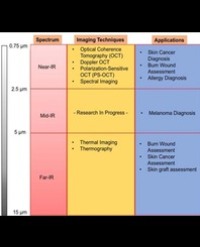
Infrared (IR) imaging is a collection of non-invasive imaging techniques that utilize the IR domain of the electromagnetic spectrum for tissue assessment. A subset of these techniques construct images using back reflected light, while other techniques rely on detection of IR radiation emitted by the tissue as a result of its temperature. Modern IR detectors sense thermal emissions and produce a heat map of surface temperature distribution in tissues. Thus, the IR spectrum offers a variety of imaging applications particularly useful in clinical diagnostic area, ranging from high-resolution, depth-resolved visualization of tissue to temperature variation assessment. These techniques have been helpful in the diagnosis of many medical conditions including skin/ breast cancer, arthritis, allergy, burns, and others. In this review, we discuss current roles of IR-imaging techniques for diagnostic applications in dermatology with an emphasis on skin cancer, allergies, blisters, burns and wounds.

Abhijit Achyut Gurjarpadhye1,2, Mansi Bharat Parekh1, Arita Dubnika1,3, Jayakumar Rajadas1,4, Mohammed Inayathullah1,5*
Article Image 1

Neuromyelitis optica (NMO)

Neuromyelitis Optica (NMO or Devic’s syndrome) is a rare demyelinating disease of the CNS that predominantly affects the spinal cord and optic nerves and shares many clinical and radiological features with multiple sclerosis. We report a case regarding a 53 year old woman who was admitted initially with hiccups and paraesthesias but was not evaluated during first 2 episodes and presented with severe progression of NMO. NMO was diagnosed with Seropositivity for NMO-IgG and longitudinally extensive spinal cord lesions (3 or more spinal segments).

Sreenivasa Rao Sudulagunta1*, Mahesh Babu Sodalagunta2, Hadi Khorram3, Mona Sepehrar4 and Zahra Noroozpour5


Article Image 1

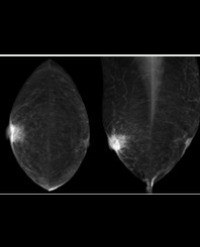
Male Breast Abscess Mimicking Malignancy: Clinical, Mammographic, Ultrasound, and Shear-Wave Elastography Findings

Male breast abscess is an extremely rare benign lesion with few published literatures and reported cases. Due to its rarity, little has been reported about its clinical or imaging features. In this report, we present a 60-year old male patient with idiopathic breast subareolar abscess mimicking malignancy in the clinical, mammography, ultrasound, and shear-wave elastography findings. Although rare, abscess should be kept in the differential diagnosis of male breast subareolar lesions mimicking malignancy.

Sung Mo Moon1, Kyung Hee Ko1, Kyong Sik Lee2 and Hae Kyoung Jung1*


Article Image 1

Hyperreactive Malarial Splenomegaly: One Clinical-Case Splenomegalie Palustre Hyperimmune: A Propos D

Introduction: The hyperimmune malarial splenomegaly is the tropical idiopathic splenomegaly (Charmot, 1959) and tropical splenomegaly syndrome (Pitney, 1968). It is linked to aberrant hyperimmune reaction to repeated malaria infections and prolonged. This article is aimed at reviewing the clinical aspects of HMS.

Observation: Here is a case of patient aged 43, Congolese, who was seen in consultation for splenomegaly. This splenomegaly was diagnosed several months before, fortuitously, on the occasion of an assessment for arthralgia and lumbago. The search of hamatozoon by sanguine smear-thick drop was positive with a parasitemy lesser than 1%. The patient has benefited of curative antimalarial treatment. After three months of treatment, splenomegaly was then measuring 9cm at ultrasound. 3 months later, the spleen was just palpable.

Conclusion: The HMS is the phase state of a specific hyper responsiveness syndrome of malaria infection. It follows the iterative Plasmodium infections for several years. This diagnosis should be evoked in patients who have lived for several years in a malaria-endemic country and present themselves with splenomegaly associated with a sharp increase in IgM. After usual antimalarial curative treatment, splenomegaly regressed in several months.

Moutaouakkil Y*, Fettah H, Makram S, Lemssaouiri J, Bennana A and Bousliman Y


Article Image 1

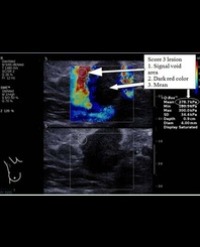
Shear Wave Elastography Characterization of Breast Lumps by using Quantitative and Qualitative Definition a Learning Curve

Objective: The study aimed to describe shear wave elastographic characteristics differentiating benign and malignant breast lumps and to establish a combined scoring system to make a diagnosis.

Material & methods: All patients over 15 years of age presented with breast lumps were included. Shear wave elastography was done by using Aixpslorer Ultrasound System Multiwave version 8.2.0 (Supersonic Imagine S.A. Aix-en-Provence, France) with Superlinear TM (SL15-4* 50 mm Super Linear Array) probe. Qualitative assessment was done on color code (ie blue, yellow, orange, red and dark red) and presence of signal void dark area. Quantitative assessment was taken in Kilopascals (KPA), where KPA mean was taken from the darkest area. All patients underwent biopsy to confirm histopathology. Each parameter was individually correlated with histopathological diagnosis; broadly categorized into benign and malignant lesions. Finally the parameters were combined to see if combination further improves diagnostic accuracy.

Results: A total of 109 patients with breast lumps were included. The dark red color code, presence of signal void area and the mean KPA >250 were independent predictors of malignant histopathology. The benign lesions showed low mean KPA and blue color code without any signal void area with exception of breast abscess. Combine score system has potential to accurately define nature of breast lumps, where score 1 defines benign and 3 defines malignant lesions, while in score 2 a great majority was malignant but a few benign lesions also fall into this category.

Conclusion: Breast lumps undergoing shear wave elastography if scored 1 having blue to orange color code, KPA

Binafsha Manzoor Syed1,2*, Jawaid Naeem Qureshi2, Ahmed Khan Sangrasi2, Champa Susheel2 and Noshad A Shaikh2


Article Image 1

Chronic Cholecystitis which Mimics Gallbladder Cancer: a Case Report

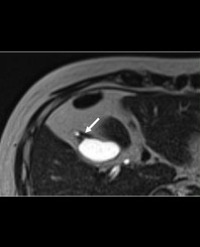
A 50-year-old male visited our hospital because he was experiencing epigastralgia. On Computed Tomography (CT), a bile duct stone was detected as a high-density material at the level of the lower biliary tract. After admission, biliary drainage by endoscopic procedures, endoscopic sphincterotomy, and stone extraction were performed. Coincidently, fundal-type adenomyomatosis of the gallbladder was suspected on Magnetic Resonance Imaging (MRI) with Magnetic Resonance Cholangiopancreatography (MRCP). Two months after hospital discharge, the biliary stone was not detected on follow-up MRI with MRCP, but focal thickening of the gall bladder had progressed in comparison to the thickness observed on previous CT and MRI with MRCP. The possibility of gallbladder cancer could not be denied; therefore, an extended cholecystectomy was performed. Histopathological examination revealed chronic cholecystitis without malignancy and no active inflammation. There was no active inflammation in the mucosa, muscularis propria, and subserosa. Quantitative visual assessment using diffusion-weighted imaging in addition to dynamic CT was useful for the diagnosis of chronic cholecystitis.

Kenji Motohashi1*, Takao Igarashi1, Hirokazu Ashida1, Kunihiko Fukuda1 and Satoru Chiba2


Article Image 1

Tracheobronchomegaly

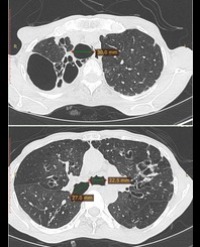
A 48 year old man occasional smoker was symptomatic since 4 years with cough with copious amount of expectoration and exertional dyspnoea and recurrent infective exacerbations. There was past history of tuberculosis 15 years back treated with empirical antituberculosis therapy for a period of 1 year. There was no significant family history. Physical examination revealed presence of post exercise desaturation, grade III clubbing and coarse crackles in bilateral lung fields. Chest Radiograph (CXR) showed the presence of bilateral cystic opacities. High Resolution Computerised Tomography (HRCT) of the chest (Figure) (1a) (1b) revealed bilateral cystic bronchiectasis and tracheobronchomegaly with tracheal, right and left main bronchus dimensions being 30 mm, 27.2 mm, 22 mm respectively. Spirometry showed Forced Vital Capacity (FVC) of 1.55 L (of predicted), Forced Expiratory Volume in 1 second (FEV1) of 1.02 L (32% of predicted), and FEV1/FVC of 66%. A diagnosis of tracheobronchomegaly-Mounier Kuhn Syndrome (MKS) was made.

Suhas HS, Ketaki Utpat, Unnati Desai and Jyotsna M Joshi*


Article Image 1

Radiologic Guide to Surgical Treatment of Kienbock

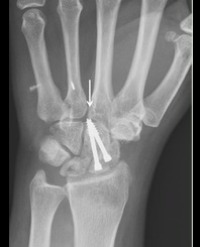
Kienbock’s disease, or avascular necrosis of the lunate, is a progressive disease ultimately resulting in end-stage arthrosis. Various surgical treatments are available for different Lichtman stages of disease. This article reviews surgical treatments of Kienbock’s disease from a radiologic perspective. The reader will learn preoperative indications and imaging, normal and abnormal post-surgical appearance and potential complications of operative treatments of Kienbock’s disease.

Erika M Nealey1, Jonelle M Petscavage-Thomas2*, Felix S Chew1, Christopher Allan3 and Alice S Ha1


Article Image 1

Lumbar Nerve Root Anomalies are Still a Diagnostic and Therapeutic Challenge. Case Report and Review of Literature

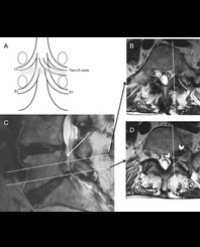
Even in the MRI era lumbar nerve root anomalies in patients with lumbar radiculopathies are still frequently un- or misdiagnosed and usually discovered during spine surgery only. The existing literature suggests that patients with lumbar nerve root anomalies are especially prone to develop radiculopathies and suffering operative complications. Therefore, preoperative diagnosis is imperative to enable appropriate surgery and avoid complications. We describe a case of a patient with unilateral lumbar radiculopathy misdiagnosed with a lumbosacral disc herniation on magnetic resonance imaging. During surgery a Neidre/MacNab type 2b lumbar nerve root anomaly rather than a disc herniation was verified, which required a wide decompression of the involved neural structures. The literature is reviewed and the clinical and radiological features of lumbar nerve root anomalies are discussed from a neurosurgical perspective.

Fabio Freguia*, Katharina Koeck*, Kirsten Schmieder and Stefan Grossauer*


Article Image 1

Microwave-Assisted Synthesis of Small and Water-Dispersible Lanthanide Doped NaGdF4 Nanocrystals for PL/CT/ MR Multimodal Imaging

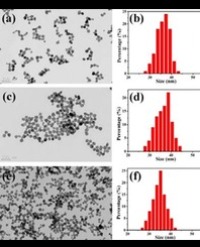
Multimodal imaging is advantageous in overcoming the deficiencies of individual imaging modalities. Herein, small, monodisperse and water-dispersible NaGdF4 : Ln (Ln = Eu, Tb, Dy) Nano Crystals (NCs) were successfully prepared in a facile manner by one-pot microwave-assisted solvothermal reaction in ethylene glycol. The morphology, size distribution, zeta potential, and crystal structure of the resulting NCs were well characterised by transmission electron microscopy, Nano-ZS90 Zetasizer, and X-ray diffraction analyses. These as-synthesised NaGdF4 : Ln (Ln = Eu, Tb, Dy) NCs exhibited a low cytotoxicity for Hela and C9H2 cells. Moreover, the doping concentrations of Eu3+, Tb3+, and Dy3+ ions were optimised for efficient Photoluminescence (PL) under the excitation of 273 nm in water. Furthermore, these NCs exhibited excellent relaxivity parameters (r1 ) in Magnetic Resonance (MR) imaging and Hounsfield units in X-ray Computed Tomography (CT) imaging in vitro. Therefore, these NCs have great potential to construct a unique platform for PL/CT/MR multimodal imaging simultaneously.

SongxiaYu1, Zhiqiang Wang2, Ruijun Cao1 and Lingjie Meng1*