Back to Journal

SM Sports Medicine & Therapy

A Multitrait-Multimethod (MTMM) Study of Fitness Assessments in College Students

[ ISSN : 3067-9788 ]

Abstract
Details

Received: 21-Nov-2017

Accepted: 22-Nov-2017

Published: 31-Oct-2017

Peter D Hart¹,²,³, Gabriel Benavidez¹‚² Nickie Detomasi¹, Andrew Potter¹, Kilby Rech¹ , Cory Michael Budak¹, Natalee Faupel¹ , Jacy Thompson¹ , Laramie Schwenke¹ , Garrett Jericoff¹, Malcolm Manuel¹, Trevail Lee¹ , Warren Edmonson¹ , Cydney Auzenne¹ , Taruha Kirkaldie¹ , Michelle Lonebear¹ and Linda Miller¹

1 Health Promotion Program, Montana State University, USA

2 Kinesmetrics Lab, Montana State University, USA

3 Health Demographics, USA

Corresponding Author:

Peter D Hart, Health Promotion, College of Education, Arts & Sciences and Nursing, Montana State University - Northern, USA, Tel: 406.265.3719; Email: peter.hart@msun.edu

Keywords

MTMM; Physical fitness; Validity; Reliability; Measurement

Abstract

Purpose: In the fitness industry, several different traits are measured using many different tests. Therefore, a need exists to study and evaluate the convergent and divergent validity of different fitness traits across their tests. The purpose of this study was to examine the measurement properties of different fitness tests designed to assess the five components of health-related physical fitness. Methods: A total of N=131 college students attending a rural public institution participated in this crosssectional study. Four different fitness tests were administered for each of the five fitness traits: cardiorespiratory, muscular strength, muscular endurance, body composition, and flexibility. A modified MultiTrait-MultiMethod (MTMM) matrix was used to simultaneously examine the measurement properties of the fitness assessments, which included internal consistency reliability, convergent validity, and divergent validity. Results: The overall modified MTMM matrix indicated strong internal consistency (alpha=0.89) across the twenty fitness tests. Each fitness component showed at least moderate reliability (alphas=0.68-0.88) with the exception of flexibility (alpha=0.38). Same trait convergent validity coefficients (CVST) were significant (ps<0.05) for all traits with exception of flexibility. Majority of different trait convergent validity coefficients (CVDT) were significant for all traits with exception of flexibility. Conclusions: Results from this study provide moderate to strong validity evidence for fitness assessments in college students. However, several tests appear to lack strong convergence with their same trait counterpart tests. Furthermore, flexibility appears to lack convergence with its same trait tests as well as other fitness trait tests.

Citation

Hart PD, Benavidez G, Detomasi N, Potter A, Rech K, Budak CM, et al. A MultiTrait-Multi Method (MTMM) Study of Fitness Assessments in College Students. SM J Sports Med Ther. 2017; 1(1): 1002.

Other Articles

Article Image 1

Insertional Achilles Tendinopathy: A Novel Approach to Diagnosis and Management

Retrocalcaneal pain is a common presenting complaint, which can lead to severe limitation of function. It is commonly due to pathology involving the Achilles tendon or inflammation of the so called retrocalcaneal bursa. Both these sites are frequent targets of medicinal injections. In some cases though, despite these measures, the problems persist. We present a series of cases whereby the symptoms were caused by fibrotic tissue in a poorly described region between the Achilles tendon and the calcaneus. We include relevant imaging to highlight the pathology.

Pastides P¹*, Babar S² and Thomas R³


Article Image 1

Imaging of Chronic Calf Strain Injuries and Adhesiolysis of Calf Aponeurosis Scarring

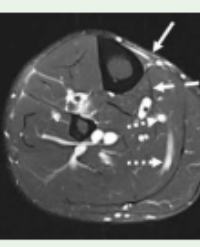
Chronic calf strain injuries are an uncommon but potentially debilitating injury which may result in significant functional impairment in runners and time lost from play in athletes. In athletes and runners with previous calf injury, we believe that scarring between gastrocnemius and soleus aponeuroses, particularly in relation to the plantaris tendon, may result in altered calf muscle biomechanics that may predispose to re-injury. Clinically, these patients may present with ‘incipient’ calf tears or recurrent calf tears. We describe the clinical and imaging findings in chronic calf strain injury and report on a new technique for the management of these injuries, calf aponeurosis adhesiolysis, which may help to restore the normal biomechanical relationship between the gastrocnemius and soleus aponeuroses and the plantaris tendon during activity.

Eamon Koh1,2, Myles Murphy3-5*, Paolo Todaro6 and Jeffrey Boyle2,7


Article Image 1

Static-Stress MRI for Evaluation of Complex Pulley-Lesions of the Finger in Sports Climber

Problem: Pulley-lesions of the fingers are typical injuries in climbing sports. In general, a rupture of the A2-pulley is found, without significant medical impact. Complex pulley-lesions may be devastating for a high-level career in sports climbing. Standard MRI in stretched finger position is not able to evaluate the A3- pulley, which is crucial for graduation of complex pulley lesions. Methods: We introduce stress MRI in a flexed finger position. This allows quantification of the distance between the palmar plate and the deep flexor tendon (A3-distance). Results: According to our data following MRI-examinations of 24 high-level sports climbers an A3-distance of 4 mm or more indicates rupture. An A3- distance up to 1 mm seems to be normal in high-level sports climber. However, due to the small sample number we did not find a clear cut-off point between strain and rupture. Discussion: The rather small and elastic A3-pulley defines the complexity of pulley-lesions. Conservative treatment is preferable if there is still continuity of the A3-pulley. Beside diagnostic imaging, Stress MRI of the fingers give some functional information about an inured A3-pulley in addition. Conclusion: Stress MRI of the fingers is an easy to perform tool for evaluation of the A3-pulley in every MRI-scanner available.

Frank Schellhammer¹ *, and Andreas Vantorre²


Article Image 1

Feasibility and Clinical Outcomes of Individualized Bone Cement Prosthetic Replacement for Advanced Lunate Bone Necrosis

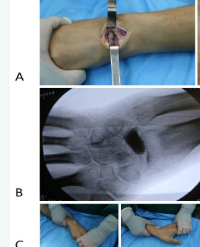
Purpose : To investigate the feasibility and clinical outcomes of individualized bone cement prosthetic replacement in treating advanced lunate bone necrosis. Methods : Nineteen patients (age > 45) diagnosed with advanced lunate bone necrosis underwent the removal of the necrotic lunate bone and replaced with an individualized bone cement prosthetic between January 2010 and December 2020. The visual analogue scale (VAS), range of motion (ROM), grip strength, MMWS (mayo modified wrist score), DASH (disability of arm, shoulder, and hand), carpal height ratio (CHR), ulnar carpal distance ratio (UDR), scaphoid translation ratio (STR), radio scaphoid angle (RSA), and the osteoarthritic were also measured to evaluate the results after at least 1year of follow-up. Results : Nineteen patients were followed up for an average of 63.21 months. At the last visit, the patient’s VAS score was (1.47 ± 0.47) points, and ROM was (130.53 ± 21.34)°, showing improvement compared to preoperative(P < 0.05), although still slightly limited compared to the unaffected side (P < 0.05); the grasp force, MMWS, and DASH scores significantly improved after surgery (P < 0.05), with no further deterioration in wrist joint function compared to postoperative results (P > 0.05). At the last visit, the CHR improved to (0.50 ± 0.06)° and the RSA to (58.8 ± 6.91)° compared to preoperative values (P < 0.05); however, the CHR was still slightly lower than the healthy side (P < 0.05). No significant changes in UDR and STR were observed after surgery (P > 0.05). Additionally, 1 case of bone cement was slightly displaced, and 3 cases showed signs of wrist joint osteoarthritis during the follow-up period. Conclusion : Individualized bone cement prosthetic treatment was effective for advanced lunate bone necrosis in middle-aged and elderly individuals. It helped restore the original anatomical structure, prevent further collapse, and enhance hand function.

Yuan-qiang Li¹ , Wan Chen¹ , Hong-Tao Li² , Xin-gang Wang² , Yu-ping Yang³* and Cheng-Song Yuan¹*


Article Image 1

Longitudinal Link between E-Bike Commuting and Total Physical Activity Increase

Background : Active commuting is a practical way to increase Physical Activity (PA). E-cycling elicits Moderate-To-Vigorous Intensity PA (MVPA) with experimental health benefits. Less is known about real-life commuter e-cycling impact on changes in MVPA, total sedentary time (SED-time), fitness and perceived health.

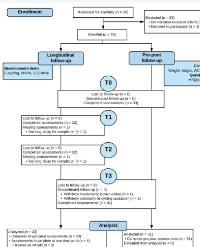
Methods : 33 subjects (min-max: 27-70 years) imminently starting commuter e-cycling were monitored for 3 to 5 months. Declarative measurements in MVPA and SED-time were analyzed by multilevel modeling. Fitness (stress test and adiposity), SF12-v2 and EMAPS scores were pre-post compared.

Results : High and stable adherence to commuter e-cycling averaged 84% (95%CI, 75-91). Mean MVPA increased and plateaued after e-cycling onset, reaching 56.7 MET-h/week (95%CI 49.9-64.3) (+21 MET-h/week over baseline). Larger increases were associated with age and e-cycling volume. High SED-time persisted over time, averaging 8.6 hours/day (95%CI, 8.1-9.) though decreasing for older and initially most sedentary subjects. Cardiorespiratory fitness improved (+0.48 METs, p=0.001) as well as effort perception, heart-rate response, waist-to-height ratio and SF12-v2 Mental Score.

Conclusions : New commuter e-cyclists experience a major increase in MVPA and a persistent high sedentary behavior, associated with benefits in fitness, adiposity and perceived mental health. Results from this pilot study need to be confirmed in larger cohorts overtime.

Bruno Chabanas¹*, Thivel D²,³, and Duclos M¹,⁴


Article Image 1

HR, Velocity Selection and PO2 during RPE Production at Sea Level vs. Altitude

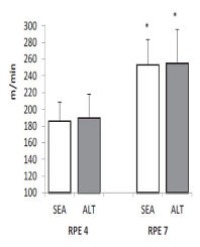
Acutely, altitude may disrupt RPE association with sea level physiological responses, potentially altering workload selection during RPE production. To assess the impact of altitude on perceptually anchored intensity regulation. Males (n=6) and females (n=6) (VO2 max = 50.1 + 7.8 ml?kg-1?min-1) completed counterbalanced production trials at sea level (SEA) and altitude (ALT, ~3400m) at RPE 4 and RPE 7, blinded to velocity (VEL) (1% grade). ANOVA’s (trial x RPE) showed no significant difference for VEL (m?min-1) within RPE 4 (SEA = 186 ± 23, ALT = 190 ± 29) or RPE 7 (SEA = 253 ± 31, ALT = 255 ± 40). However, PO2 (%) was significantly lower for ALT within RPE 4 (96.4 ± 2.0 vs. 83.5 ± 5.4) and RPE 7 (97.2 ± 0.9 vs. 83.1 ± 3.4). HR (b?min-1) was significantly higher for ALT within RPE 4 (133 ± 19 vs. 153 ± 17), and RPE 7 (163 ± 18 vs. 175 ± 12). Session RPE was not significantly different between SEA and ALT within RPE 4 (ALT = 3.9 ± 0.8, SEA = 3.7 ± 0.7) or RPE 7 (ALT = 6.7 ± 0.5, SEA = 6.8 ± 0.8). Physiological variables (HR, PO2) seem subsidiary to workload (VEL) in mediating the RPE production paradigm at altitude with those observations consistent for Session RPE. Correspondence between perceptual responses and other physiological factors, (lactate, VO2, etc) at altitude warrants further consideration including responses across varying fitness levels, exercise modalities and following acclimatization periods.

James M. Green1*, Jeffrey D. Simpson2, and Brandon L. Miller3