SM Journal of Urology

Archive Articles

Article Image 1

Negative Association of Chronic Inflammation with High-Grade Prostate Tumors Treated by Radical Prostatectomy

Background: Chronic inflammation of the uninvolved prostate has been identified as a potential contributor to the onset and progression of prostate cancer. The goals of this study were to identify the prevalence of chronic inflammation associated with high-grade prostate tumors and to investigate chronic inflammation’s relationship with pathological stage and grade.

Materials and Methods: Consecutive series, retrospective chart review of pathologic data collected from 519 prostate tumors treated by radical prostatectomy. Histological evidence of chronic inflammation was assessed in prostate tissue specimens. Tumor differentiation and aggressiveness was quantified by final Gleason score and final pathologic stage (AJCC TNM staging system) assigned by surgical pathologist. Spearman’s Rho non-parametric correlation was performed to measure the respective relationships of chronic inflammation with Gleason score and with pathologic stage.

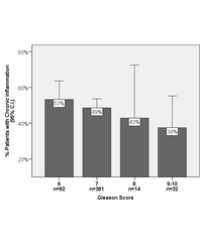
Data/Results: Chronic inflammation of the uninvolved prostatic tissue was observed in 255 of the 519 prostatectomy specimens (48.6%). Chronic inflammation was inversely associated with final pathologic stage (T2-T4), corresponding with the following prevalence rate: T2a: 71.4%, T2c: 49.3%, T3a: 42.6%, T3b: 31.4%, T4: 0% (Spearman’s rho = -.167, p < .001). Additionally, chronic inflammation was inversely associated with Gleason scores (GS6- GS10), corresponding with the following prevalence rates: GS6: 54.2%, GS7: 48.4%, GS8: 42.9%, GS9: 38.7, GS10: 0% (Spearman’s rho = -.065, p = .138).

Conclusions: Chronic inflammation in the uninvolved prostate has been identified as a potential mediator of prostate cancer. The study data indicates that chronic inflammation was present in less than 50% of highgrade prostate cancers treated by prostatectomy. An inverse association between the prevalence of chronic inflammation and final pathologic stage was identified. A similar trend towards decreasing Gleason score in prostate cancers associated with chronic inflammation was noted. The study data indicates that poorly differentiated, highly aggressive prostate cancers are less likely to be associated with chronic inflammation.

Timothy Stark1*, Daniel Davenport2 and Stephen Strup1


Article Image 1

Collecting Duct of Bellini Renal Carcinoma

Collecting Ducts Carcinoma (CDC), also known as Bellini Duct Carcinoma (BDC), is a rare variant of Renal Cell Carcinoma (RCC) arising from the epithelium of the distal collecting ducts. It has an aggressive course and poor treatment response. Up to date, there are only few reports of CDC, which may be due to unrecognized or unfamiliarity of its features and characteristics. Therefore, we present a retrospective study was done in 5 cases of CDC and makes a systematic review of the literature.

Liu J1,2,3*, Li Y1,2,4*, Su Z1,2,3, Duqun Chen1,2,4, Ni L1,2, Mao X1,2, Yang S1,2 and Lai Y1,2


Article Image 1

An Uncommon Cause of Urge Urinary Incontinence in Female Patient: Huge Bladder Stone

Bladder Stone accounts for 5% of all urinary tract stones. In addition to this, bladder stones are generally seen in male patient and solitary bladder stone is more commonly seen rather than multiple stones. Yet, huge bladder stone over 100 gram is very rare at the published literature, especially in female patient. In this study, we present a female patient presented with urge urinary incontinence and diagnosed with bladder calculi weighed as 780 gram and bilateral hydroureteronephrosis. Patient got relieved all of her complaints secondary to bladder stone and hydroureteronephrosis resolved spontaneously by successful open cystolithotomy. To the our knowledge, this is the first case in the published literature related to huge bladder calculus in female patient without any concomitant disorders facilitated to bladder stone formation such as infravesical obstruction, foreign body and urinary tract infection.

Cem Basatac1* and Mehmet Cagatay Cicek1


Article Image 1

An Unusual Foreign Body in the Urethra

Bladder and urethral foreign bodies are sometimes seen in daily medical practice. We experienced a rare case of the urethral foreign bodies. A 24 years-old man was referred to our hospital due to the insertion of 3 pieces of 12×6mm disc-shaped acrylic beads together with J shaped bougie into the urethra. Bougie was removed easily but beads were stuck in the urethra. We fail to remove the beads with the basket, but we finally able to remove by using hooked-prong grasping forceps through nephroscope for percutaneous nephrolithotomy (PNL). It is critical to chose right surgical tools based on the shape and material of the foreign bodies to attain minimal invasiveness.

Kei Yoneda1 , Shinichi Sakamoto2*, Akinori Takei2 , Miki Fuse2 , Koji Kawamura2 , Takashi Imamoto2 , Hiroyoshi Suzuki1 and Tomohiko Ichikawa2


Article Image 1

Chain of Stones in Distal Ureter: Is there any Role of Open Ureterolithotomy in Era of Endourological Intervention

Aim: To highlight the role of open ureterolithotomy in the management of ureteral stones in the era of minimally invasive therapies.

Material and Methods: Between January 2008 and August 2014, 18 patients (mean age 38.7 years) with multiple impacted mid and lower ureteral stones with large stone bulk (mean size 7.8 cm, mean number of stones- 6.3) and normal renal function underwent open ureterolithotomy. Ten patients had stones on left side and the remaining eight had on the right side.

Results: The open extraperitoneal ureterolithotomy was successful with complete clearance in all cases. The mean operating time was 63.7 minutes (range 56–82 minutes). The mean blood loss was 89.5 ml (range 67- 102 ml) with a mean hemoglobin drop of 0.82g/dL (range 0.5-1.1 g/dl). Mean dose of diclofenac required in postoperative period for pain relief was 187.3 mg. Prolonged urine leakage from drain occurred in one patient and post-operative fever occurred in two patients. The mean hospital stay was 3.6 days. The mean convalescence period was 12.3 days. No major intraoperative or post-operative complications were observed. All patients were stone free, asymptomatic and without stricture formation or obstruction after mean follow-up period of 29.3 months.

Ankur Bansal1*, Bimalesh Purkait1 , Manoj Kumar1 , Satyanarayan Sankhwar1 ,Ruchir Aeron1 and Sunny Goel1


Article Image 1

Diarrhoea as a Presenting Feature of Renal Cell Carcinoma, a Case Report and Review of Literature

Presentation of renal cell carcinoma is quite variable. Only in 10% cases, it present with classic features of flank mass, hematuria and pain. Uncommon presentation may mislead the diagnosis and management. We are reporting a patient who initially present with diarrhoea as presenting symptoms of renal cell carcinoma.

Ashok Kumar Gupta1*, Bimalesh Purkait1 , Kawaljit Singh1 , Ashok Kumar Sokhal1 and Durgesh Kumar Saini1


Article Image 1

Finasteride in Prostate Cancer: A Hope or Hype

The guest editors of this special issue and research scientist all across the globe, working on urology problems and prostate cancer have been asked by the editorial board of the SM journal of urology to collect and publish articles on prostate cancer so as to document the latest developments in this field. The intricacies and challenges of tackling this disease continue to puzzle and fascinate us. This particular issue on prostate cancer includes original research works, reviews, commentaries as well as debate and opinion pieces.

Neelima Dhingra*


Article Image 1

Diabetes Mellitus is Associated with High Grade and High Stage in Urinary Bladder Cancer

Introduction: Diabetes Mellitus (DM) is increasing worldwide health problems. Several studies have proposed an epidemiological association between DM and bladder cancer. CIS is a high-grade carcinoma with the potential for invasion and metastases. We aimed to reveal association between DM, CIS and tumour characteristics of patients with bladder cancer.

Material and Method: We retrospectively analyzed 615 patients between January 2007 and December 2014 who diagnosed bladder cancer and performed TUR-BT or radical cystectomy. All patients with bladder cancer separated two groups as Non-Muscle Invasive Bladder Cancer (NMIBC) and Muscle Invasive Bladder Cancer (MIBC). Each groups separated two groups inside them as diabetic or non diabetic.

Results: We analyzed 615 patients with bladder cancer. There was statistically significance for relapse frequency was higher in diabetic patients than non-diabetic patients. T, N and M stages were more advance in diabetic patients. Although concurrent CIS is higher in diabetic patients, squamous metaplasias between diabetic and non-diabetic patients were not significant.

Discussion: Diabetes is the critical worldwide health problem that has serious complications that can cause much kind of cancers. We revealed that there is negative effect of diabetes on patients with bladder cancer especially patients with CIS.

Conclusion: Patients with diabetes had advanced stage, grade and concurrent CIS than patients without diabetes. And also, diabetic patients have more recurrent disease than non-diabetic patients.

Mustafa Ozan Horsanali1*, Kutan Ozer1 , Sacit Nuri Gorgel1 and Emin Ozbek2


Article Image 1

Acute Aortic Thrombosis after Radical Cystectomy

The occurrence of an acute lower limbs ischemia after pelvic surgery is very rare. We report a third case in the literature of acute aortic thrombosis in the immediate postoperative radical cystectomy. This complication can be fatal due to ischemia-reperfusion or extension of the thrombus. Understanding the risk factors will prompt high-risk patients to have a vascular surgery consultation, and take precautions including intra-operative hemodynamic stability and adequate position.

Mohamed A Samkaoui1 , Youssef Louardi1, Youssef Zarrouki1 , Manal Rhezzali1 , Abdelhamid Hachimi2*, Said Moudouni3 and Amra Ziadi1