HR, Velocity Selection and PO2 during RPE Production at Sea Level vs. Altitude
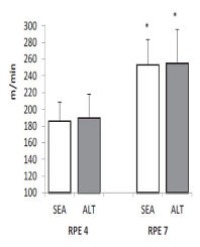
Acutely, altitude may disrupt RPE association with sea level physiological responses, potentially altering workload selection during RPE production. To assess the impact of altitude on perceptually anchored intensity regulation. Males (n=6) and females (n=6) (VO2 max = 50.1 + 7.8 ml?kg-1?min-1) completed counterbalanced production trials at sea level (SEA) and altitude (ALT, ~3400m) at RPE 4 and RPE 7, blinded to velocity (VEL) (1% grade). ANOVA’s (trial x RPE) showed no significant difference for VEL (m?min-1) within RPE 4 (SEA = 186 ± 23, ALT = 190 ± 29) or RPE 7 (SEA = 253 ± 31, ALT = 255 ± 40). However, PO2 (%) was significantly lower for ALT within RPE 4 (96.4 ± 2.0 vs. 83.5 ± 5.4) and RPE 7 (97.2 ± 0.9 vs. 83.1 ± 3.4). HR (b?min-1) was significantly higher for ALT within RPE 4 (133 ± 19 vs. 153 ± 17), and RPE 7 (163 ± 18 vs. 175 ± 12). Session RPE was not significantly different between SEA and ALT within RPE 4 (ALT = 3.9 ± 0.8, SEA = 3.7 ± 0.7) or RPE 7 (ALT = 6.7 ± 0.5, SEA = 6.8 ± 0.8). Physiological variables (HR, PO2) seem subsidiary to workload (VEL) in mediating the RPE production paradigm at altitude with those observations consistent for Session RPE. Correspondence between perceptual responses and other physiological factors, (lactate, VO2, etc) at altitude warrants further consideration including responses across varying fitness levels, exercise modalities and following acclimatization periods.
James M. Green1*, Jeffrey D. Simpson2, and Brandon L. Miller3