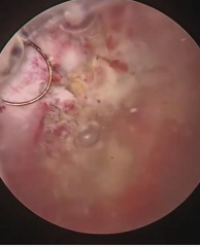
Atypical Multiple Cavernous Hemangiomas of the Urinary Bladder: Successful Management Via Resection and Base Fulguration
Objectives : The primary objective of this case report is to review the clinical presentation, diagnostic methods, treatment, and outcomes associated with cavernous hemangioma of the urinary bladder. We aim to enhance awareness among healthcare professionals regarding this rare entity and improve management strategies for similar cases.
Introduction : Cavernous hemangioma of the urinary bladder is a rare vascular tumor that arises from the proliferation of blood vessels. While it can occur in various anatomical locations, its incidence in the bladder is particularly low, accounting for approximately 0.6% of urinary bladder tumors, with painless hematuria being the most common presenting symptom. The most frequent locations in the bladder are the base, posterior wall, and trigone. This condition presents diagnostic challenges due to its nonspecific symptoms, which often overlap with more common urological disorders. Cavernous hemangiomas are typically found in organs such as the liver, skin, or brain, where they are usually asymptomatic unless their size or location causes symptoms. Complete surgical excision is generally curative. Methods : A comprehensive literature review was conducted, focusing on case reports and studies published in peer-reviewed journals. The review iden
tified several cases of cavernous hemangioma, most commonly presenting with hematuria, urinary frequency, and pelvic pain. Imaging modalities such as ultrasound and CT scans revealed heterogeneous masses, often leading to differential diagnoses. Surgical excision emerged as the predominant treatment method.
Results : Most patients experienced favorable outcomes with no recurrence during follow-up.
Conclusion : Cavernous hemangioma of the urinary bladder, although rare, should be considered in the differential diagnosis of bladder masses, particularly in patients presenting with unexplained hematuria. Early diagnosis and appropriate surgical intervention lead to excellent long-term outcomes. Increased awareness and further research are essential to refine management protocols and improve patient care.
Haitham Abdalla Shello*