SM Preventive Medicine and Public Health

Current Issue

Article Image 1

The association of eye health with contact lens purchasing channels and wearing habits in metropolitan Taiwan

Objective: To assess the effect of purchasing behaviour and wearing habits of consumers on the incidence related to the health of eye.

Methods: Questionnaires about the purchasing behaviour and wearing habits of consumers were randomly and anonymously sent to register optical shops in Taiwan. The collected data included information about participants and contact lens categories, purchasing channels, and wearing habits of participants; types and causes of eye discomfort; and understanding of hygiene of participants.

Results: A total of 255 participants who wore contact lenses completed the questionnaire. The channels for purchasing contact lenses were mainly optical shops (75.3%), but drugstores, superstores, and online platforms were also attractive channels (10%–20%) for young participants. Nearly 25% of participants wore contact lenses to sleep overnight. The top three reasons for eye discomforts were dryness (78.8%), foreign body sensation (67.1%), and red eyes (52.9%). The most common causes of eye discomfort were overuse (35.3%) and problems with cleaning (25.9%). When purchasing contact lenses, approximately 52% of participants did not receive instructions from a professional about hygiene, cleaning, and maintenance. Approximately 41% did not receive an optometric evaluation. Most participants knew that a package insert accompanied the product (67.1%), but only 27% read the insert in detail and most (72.9%) were unsure about all the product specifications.

Conclusions: When professionals are involved in the purchasing process, consumers receive concrete assistance with respect to safety usage of contact lenses which may reduce the incidence of eye discomfort.

Chao Kai Chang¹, Cheng Ke Hsu¹, Iebin Lian², and Ching Yao Huang¹*


Article Image 1

Factors Influencing Early Weaning Practices among Nursing Mothers in Kano Municipal LGA: A Focus on Socio-Demographic and Psychological Aspects

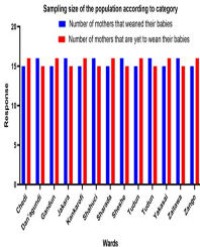
Early weaning remains a critical public health issue, especially in low-resource settings, with significant implications for child health and development. This study explores the socio-demographic, economic, and psychological factors influencing early weaning practices among mothers in Kano Municipal LGA, Nigeria. Using a combination of stratified and simple random sampling, we surveyed mothers across diverse wards to ensure balanced representation of weaning and non-weaning practices. Findings reveal a strong correlation between socio-economic hardship, inadequate living conditions, and maternal stress with early weaning decisions, despite widespread recognition of breastfeeding’s benefits. Economic pressures, insufficient family planning, and misconceptions surrounding milk supply often led mothers to substitute breastmilk with cow’s milk and porridge, contributing to stunted growth and potential reductions in leptin levels for prematurely weaned infants. These results highlight the urgent need for targeted interventions addressing cultural, economic, and psychological barriers to breastfeeding. Prioritizing accessible education, socio-economic support, and maternal mental health resources could improve breastfeeding adherence, ultimately enhancing child health outcomes and supporting long-term public health goals.

Lawan Rabiu1,2, Musa A. Aminu1, Mustapha I. Muhammad1, Muhammad A. Saliu3 and Nura Muhammad Sani1,2*


Submit a Manuscript