E Liakou1,2, A Τsiantoulas1,2, S Fragidis2 , P Giamalis1 , M Tsiatsiou1, Κ Papazoglou3 and Α Papagianni1*
1Department of Nephrology, Aristotle University of Thessaloniki, Greece
2Haemodialysis Unit, Bioclinic, Greece
3Department of Surgery, Aristotle University of Thessaloniki, Greece
Corresponding Author:
Α Papagianni, Professor of Nephrology,
Department of Nephrology, Aristotle
University of Thessaloniki, Hippokration
General Hospital, 49 Konstantinoupoleos
Str, 54642 Thessaloniki, Greece,
Tel: +30 2310 992856;
Keywords
Abdominal aortic aneurysm;
Endovascular aneurysm repair;
Hemodialysis; Mortality; Open surgical
aneurysm repair
Abstract
Aim: End-Stage Renal Disease (ESRD) patients on renal replacement therapy have increased cardiovascular morbidity and mortality rate and are at high risk for the development of Abdominal Aortic Aneurysms (ΑΑΑs). The aim of the present study was to investigate the management and outcome of ΑΑΑs in chronic hemodialysis patients.
Patients-Methods: During the period 2010-2015, an AAA was diagnosed in 19 ESRD patients. Thirteen out of them underwent Endovascular Aneurysm Repair (EVAR), 1 patient underwent Open Surgical Repair (OSR) and 5 patients were on regular follow-up.
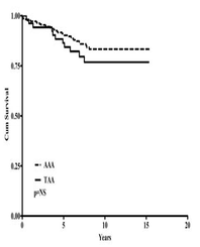
Results: During the 6 year follow-up period, an endoleak was recorded in 7 out of the 13 aneurysms (36.8%). Endoleak was an early complication in one patient (14.3%) and late in six (85.7%) and was successfully managed with a repetitive EVAR in all cases. Five patients (26.3%) died including the patient who underwent OSR. The causes of death were sepsis in 3 patients (60%), device migration and aneurysm rupture in 1 patient (20%) and cerebrovascular accident in 1 patient (20%).
Conclusions: In end-stage renal disease patients with abdominal aortic aneurysms, EVAR is a safe therapeutic option with low both peri-operative and long-term morbidity and mortality.
Citation
Liakou E, Τsiantoulas A, Fragidis S, Giamalis P, Tsiatsiou M, Papazoglou K, et al.
Management and Outcome of Abdominal Aortic Aneurysms in End-Stage Renal Disease Patients: A Case Series. SM Vasc Med. 2017; 2(1): 1011.