SM Journal of Hematology & Oncology

Archive Articles

Article Image 1

Prevalence of Anemia and Hematological Profiles among Medical Students at Sana’a University: A High Altitude Cross-Sectional Study

Background: Anemia remains a significant global public health challenge. However, its prevalence among health professions students residing in high-altitude regions—where physiological adaptations may alter standard hematological parameters—is not well documented. This study aimed to determine the prevalence of anemia and evaluate the complete hematological profiles of medical students at Sana’a University, Yemen, a city situated at approximately 2,250 meters above sea level. Methods: A cross-sectional study was conducted among 100 undergraduate students (51 males and 49 females) aged 19–25 years at the Faculty of Medicine and Health Sciences, Sana’a University. Venous blood samples were collected and analyzed for Complete Blood Count (CBC) parameters using an automated Sysmex XN-330 hematology analyzer. Anemia was initially defined according to the World Health Organization (WHO) sea-level criteria (hemoglobin [Hb]

Results: The overall mean hemoglobin concentration was 15.63 ± 1.73 g/dL. Sex-stratified analysis revealed significantly higher mean Hb levels in males (16.96 ± 1.20 g/dL) compared to females (14.24 ± 0.91 g/dL) (p < 0.001). Other mean hematological indices were as follows: packed cell volume (PCV) 47.05 ± 4.73%, Red Blood Cell (RBC) count 5.43 ± 0.59 × 10¹²/L, Mean Corpuscular Volume (MCV) 86.39 ± 7.63 fL, and Mean Corpuscular Hemoglobin (MCH) 28.82 ± 2.24 pg. Using the unadjusted WHO sea-level criteria, the prevalence of anemia in this cohort was 0%. However, applying the recommended WHO altitude adjustment for Sana’a (+1.0 g/dL) revises the diagnostic thresholds to 14.0 g/dL for males and 13.0 g/dL for females, potentially identifying anemic cases, particularly among female participants. Conclusion: No anemia was detected in this sample of medical students using standard sea-level criteria, a finding likely attributable to high health literacy and physiological adaptation to Sana’a’s altitude. This study highlights the critical need to establish altitude-specific hematological reference ranges for the Yemeni population to prevent the misdiagnosis of anemia in high-altitude regions.

Ghadeer Y. Al-Anssi1, Khater Gh. H. AL-Hamoodi2, Mubarak Gh. H. AL-Hamoodi3, Tibyan Abd Almajed Altaher4, and Ghanem Mohammed Mahjaf5*

Article Image 1

Efficacy Trajectory and Hematologic Safety of Oral JAK Inhibitors in Elderly Patients with Moderate-To-Severe Atopic Dermatitis: A Prospective Real-World Study

Background: Elderly patients with moderate-to-severe Atopic Dermatitis (AD) often have multiple comorbidities and immunosenescence, raising concerns regarding the efficacy and safety of systemic therapies. Real-world evidence on oral Janus Kinase (JAK) inhibitors in this population remains limited. Methods: In this prospective real-world cohort, 90 elderly patients with moderate-to-severe AD received abrocitinib or upadacitinib and were followed for up to 36 weeks. After early discontinuations, 80 patients were included in the final analysis. Disease severity (EASI, SCORAD, and DLQI) and laboratory parameters were assessed longitudinally, and linear mixed-effects models were applied to identify factors associated with treatment response. Results: Both JAK inhibitors induced rapid and sustained clinical improvement. EASI50, EASI75, and EASI90 response rates increased as early as Week 4 and reached a stable plateau after Week 16. Upadacitinib was associated with faster and greater early improvement, whereas long-term efficacy was comparable between groups by Week 36. SCORAD and DLQI scores decreased significantly throughout follow-up (both P < 0.001). Shorter disease duration, treatment with upadacitinib, and higher body mass index were independently associated with greater EASI improvement. Both treatments were generally well tolerated. Herpes zoster occurred more frequently in the upadacitinib group but was mild to moderate and manageable, and no serious adverse events were observed. Conclusions: In elderly patients with moderate-to-severe AD, both abrocitinib and upadacitinib demonstrated rapid, durable efficacy and an acceptable safety profile in a real-world setting, with upadacitinib showing a modest advantage in early disease control.

Lin Zhang1, Sirong Xie1, Hongze Han2, Yidi Zhu3, Zhiping Wei1*and Guan Jiang1#


Article Image 1

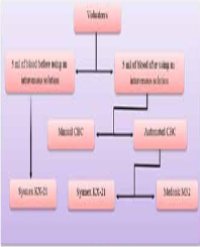
Comparative Study between Automated and Manual Methods of Complete Blood Counting in Patients Using Intravenous Solutions

Objective: This study examines the impact of diluting IV fluids on blood parameters using two automated haematology analyzers (Sysmex KX-21 and Medonic M32) alongside manual techniques, highlighting the importance of laboratory services in healthcare and medical diagnosis. Materials and Methods: Blood samples were collected before and after intravenous administration of solutions and sent to the laboratory for measurement of hematological parameters, including Hb, RBC count, WBC count, PCV, MCV, MCH, and MCHC. Additional samples were collected after administration of intravenous solutions. Results: Sysmex KX-21 showed higher hematocrit and mean corpuscular volume than manual methods and Medonic M32. However, both showed significantly lower mean corpuscular hemoglobin compared to manual measurements. Medonic M32 had an elevated mean corpuscular hemoglobin concentration. White blood cell counts were comparable between Sysmex KX-21 and manual methods, with Medonic M32 showing lower counts, though the difference was not statistically significant. Conclusion: Automated haematological analyzer readings are as reliable as the standard manual method. WBC count, RBC count, Hb, and Hct were the most commonly affected by intravenous solutions when automated haematology analyzers and manual methods were used to measure them. WBC, MCH, and MCHC were slightly affected by intravenous solutions. RBC and MCHC by the Medonic M32 automated haematology analyzer were slightly higher than those by the Sysmex KX-21 automated haematology analyzer and the manual method. HCT and MCV by the Sysmex KX-21 automated haematology analyzer were higher than those by the Medonic M32 automated haematology analyzer and the manual method.

Mohammed AL-Dulaiei1-3*# and Bakeel A. Radman4,5#