Microbiological Response to Copper Contamination in a Irrigation Silt Soil
Soil contamination by copper (Cu) causes a severe loss of crop production in China due to rapid industrialization. A laboratory
incubation experiment with varied levels of Cu was conducted to study toxic effects of Cu contamination on microbiological properties
of Irrigation silt soil. Basal respiration (BR), microbial biomass C (Cmic), and microbial quotient (MQ) were stimulated low levels of
external Cu loadings (<50 mg kg-1), but were inhibited at higher rates (>400 mg kg-1). Microbial metabolic quotient (MMQ) was
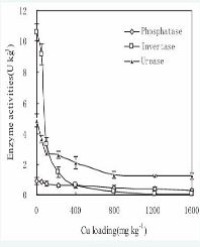
significantly enhanced. Increasing Cu loading decreased enzyme activities, by 65.6% for phosphatase, 99.5% for invertase, and
74.7% for urease. Color development rate and richness were accelerated, and Shannon diversity and Shannon evenness increased
at low levels of external Cu loadings (<50 mg kg-1), but the reverse was true at higher Cu rate (400 mg kg-1), as estimated by the
Biolog procedure. External Cu loading affected the amounts of individual fatty acids and their ratios. The saturated fatty acids were
increased by 144% and 74%, respectively at the rates of 100 and 400 mg kg-1 Cu, as compared to the control. Gram negative
bacteria were increased by 10.1% and 20.6%, and actinomycete by 10% and 8% respectively, whereas fungi were decreased
11.8% and 66.1%, respectively at the loading rates of 100 and 400 mg kg-1 Cu. These results indicate that microbial biomass, basal
respiration rate, and enzyme activities and microbial community structure in the Irrigation silt soil are sensitive to Cu contamination
and can serve as indicators of Cu contamination.
Kaiyi Fan1*, Mengze Wang2,3, Jun Yao2, Bo Ma2, Ning Min2 and Tatyana Kouznetsova3