Background: In 2014, Manitoba introduced legislation authorizing pharmacists to administer four publicly funded vaccines to patients seven years of age and older. As part of an expanded scope of practice initiative, pharmacists could administer the Human Papilloma Virus (HPV) vaccine, Tetanus-diphtheria-acellular pertussis (Tdap) vaccine, Pneumococcal Polysaccharide (PPV23) vaccine, and seasonal influenza (FLU) vaccine. Pharmacists began administering the four vaccines as of September 1, 2014, three weeks before the influenza immunization campaign began. This study assesses the initial impact that pharmacists had on the population uptake of the seasonal influenza vaccine as well as the other three publicly funded vaccines.
Methods: The data for this study were obtained from Manitoba Immunization Monitoring System (MIMS), the population-based and province-wide immunization registry. We analyzed immunizations of the four publicly funded vaccines administered by all immunization providers in Manitoba during two periods: September 1, 2013 to January 31, 2014 (2013-2014) and September 1, 2014 to January 31, 2015 (2014-2015).
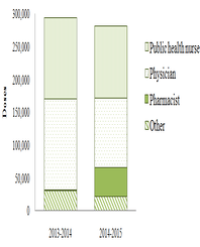
Results: Between September 1, 2014 and January 31, 2015, within the first few months after pharmacists in Manitoba began immunizing patients, they administered 44,220 doses of HPV, Tdap, PPV23 and FLU in total. They contributed significantly to the FLU immunization program, and were the third largest provider, especially for urban residents and patients aged 45 and older. Overall, they administered 43,638 FLU doses (15% of the provincial total). The number of FLU immunizations provided by physicians decreased by 32,573 doses; however, physicians administered more immunizations to the six months to five years age group in 2014-2015 (12,445) than in 2013-2014 (11,969).
Conclusion: Pharmacists’ participation in Manitoba’s publicly funded immunization program has been well accepted in Manitoba. However, the provider expansion did not increase the uptake of the FLU vaccine in the 2014-2015 season. Regardless, the participation of pharmacists in the provincial immunization program increases access to immunizations, and could reduce pressure on other primary care providers. This could potentially decrease wait times and increase availability of appointments for patients with more serious medical issues. Further studies are required.
Yichun Wei1*, Songul Bozat-Emre1,2, Inga Hossack1 and Tim Hilderman1,2