JSM Veterinary Medicine and Research

Archive Articles

Article Image 1

Effect of spirulina level on post-weaning growth of guinea pig Cavia porcellus in western Cameroon

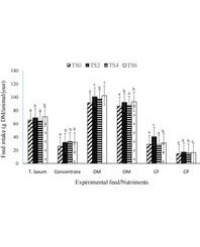
For post-weaning growth performance evaluation in Guinea pig (Cavia porcellus), an 8-week trial was conducted in West Cameroon. 59 weaned animals (3 weeks of age) from a breeding trial were used. After identification and weighing, animals were submitted on the same treatment as their mothers. Each animal receives daily between 8 and 9 am, an experimental food corresponding to its group. Animals of TS0 group received Trypsacum laxum and the concentrate with 0% spirulina, while others received in their diets 2% (TS2), 4% (TS4) and 6% (TS6) spirulina. Food refusal was collected and weighed before the new distribution, for feed intake determination. During the growth period, T. laxum, concentrate and nutrients (Dry Matter (DM), Organic Matter (OM), Crude fiber (CF) and Crude Protein (CP)) intake was significantly affected by treatments. Highest animal average weight (407.0g) was obtained with treatment TS2 and the lowest (396.64g) with control (TS0). The same tendency was observed with total (TWG) and daily weight gain (DWG). Thus, the highest TWG and DWG (222.06 g and 6.34 g / day) were obtained in TS2 treatments while the lowest (194.82 g and 5.57 g / day) was obtained with TS0. At 8 weeks regardless of the birth type, highest average weight, total and daily weight gain was obtained with treatment TS6. At the same period for the same parameters, no significant difference was observed between treatments TS0, TS2 and TS4. Based on the result, food intake as animal body weight can be improved by 2% of spirulina in the diet but at 6%, growth performance can be improved mostly for the twin’s births

Généviève NGUEDIA1 , Emile MIÉGOUÉ1*, Fernand TENDONKENG1 , Camara SAWA2 , Henry FEULEFACK DEFANG3 , Josué FOSSI1 , Mouchili MAMA1 , Dayan Agwah EBILE1 , Yannick FONGANGet Etienne TEDONKENG PAMO1


Article Image 1

Urgent Call for Action: Avoiding Spread of MosquitoBorne Diseases as a Major Public Health Problem

Mosquitoes are the most important vectors of pathogenic organisms. Diseases like malaria, dengue fever, yellow fever, zika and West Nile encephalitis have emerged or re-emerged in several countries of the world during the past decades [1-4].

These diseases have been ranked by World Health Organization (WHO) as the most important tropical diseases in the worldbecause each year, insects and other vectors transmit infectious pathogens to more than one billion people, causing more than 700,000 deaths worldwide [5]. The impact of these diseases on human and animal is enormous. They affect productivity and cause a vicious spiral of poverty and disability and in another hand affect food production and contribute to economic lost in different ways [6]. The distribution and seasonality of many of these diseases may be influenced by climate change. Mosquitoes are sensitive to temperature, humidity, rainfall patterns, for example when the temperature increaseswould tend to accelerate mosquito life cycles and would also decrease the incubation period of the parasite or virus. The weather patterns and other aspects of climate change can to contribute that the mosquito’s diseases will be increase [7]. These observed climatic changes have led to further water storage with accompanying poor water protection and scanty community participation creating more breeding sites for mosquitos like Aedesaegypti principal responsible of arbovirus transmission like dengue, zika, chikungunya and others [8]. For malaria vectors the rainfall patterns bring several temporal natural breeding sites and contribute to malaria transmission4 .Impacts on health would entail the emergence of a disease in new areas as well as the extension of the transmission season in areas where it is present [4,9], besides willbe to changes the geographical range of these vector/borne diseases for example the chikungunya outbreaks in Europe [10].

Maria del Carmen Marquetti Fernández1* and Andrés Bisset Marquetti2


Article Image 1

A Review on Bacterial and Fungal Diseases in Dogs

The objective of this article was to briefly review about the most common bacterial and fungal infections in pet animals especially dogs by describing information about the causative agent, clinical signs and symptoms, route of transmission and diagnosis of the infection. In last years, the pet population has increased and the interest in having pets where are became sharing in our daily life in many purposes such as protection, entertainment, hunting and helping their owner, etc... . Thus, the increase of the knowledge and awareness of dog owners regarding these diseases enable them to significantly reduce the occurrence of these infections. Bacterial infections such as Pasteurella, Salmonella, Brucella, Yersinia enterocolitica, Leptospira, Campylobacter, Bordetella bronchiseptica, and Coxiella burnetii, and fungal infections including Aspergillosis, Candidiasis and Dermatophytosis are the most common bacterial and fungal infections affecting dogs

Mohammad Elshahat Abd Alfatah*


Article Image 1

Phenotypic Characterization of Local Chickens (Gallus Gallus Domesticus) In Bekwarra Cross River State, Nigeria

This study was conducted in Bekwarra Local Government Area of Cross River State, Nigeria, to identify and determine some characteristics of local chickens. A total of 530 adult chickens of both sexes and 111 fresh eggs were carefully examined at seven administrative council wards of the local government. About 43.00% of the birds observed were male while 57.00% were females. Statistical Package for Social Sciences (SPSS) was employed to carry out descriptive statistics on qualitative and quantitative data of identified chicken population in the respective areas.The result showed predominantly pea comb type (38.90%). Eye color was black (44.72%), light-brown (14.91%), dark-brown (12.83%), dark-red (11.30%), orange (11.32%), and pink (1.10%). For plumage colour, 36.23% were classified as black, 20.00% as white, 13.02% as brown, 9.43% as red, 7.93% as multicolored, 3.21% as black-white, 3.02% as grey, 2.45% as grey-white, 2.26% as black-brown, 0.94% as ash-black and 0.57% as ash respectively. Most chickens (31.90%) had yellow shanks, while 19.60%, 18.50%, 11.30%, 6.40%, 5.10%, 3.40%, 3.00%, 0.40%, had white, greenish, milky, ash, dark-ash, pink, red, and light brown respectively. An average live, body circumference, body length, shank, head and neck length were; 1.80kg, 42.7 ± 0.03cm,55.8 ± 0.21cm, 12.20 ± 0.4cm, 5.1 ± 0.03cm, and 8.9 ± 0.5cm. The average egg width, egg length and egg weight were; 5.2 ± 0.03cm, 7.6 ± 0.01cm, 31.6 ± 0.05g with 12 clutch size and 3 clutches per hen per year. The indigenous chicken population in Bekwarra, Nigeria, is mostly black with black eyes, white eggs and yellow shank. There were distinctive differences in almost all the measurable traits parameters examined. These distinctions provide the basis for which they could be classified and improved.

Odah, E. O1*, Daikwo, S. I1 , Mbap S.T2 , and Okpanachi U3


Article Image 1

Study of Milk Yield and Factors Contributing to the Yield in Jersey and Holstein Breeds of Cattle in Rupandehi District

Survey was conducted in Mainahiya Village Development Committee, HarnaiyaVillage Development Committee, TilottamaMunicipality and Devdaha Municipality of Rupandehi district in the year April 2015 in order to study the milk yield and milk parameters in Jersey and Holstein cattle. Total sampling household were 13 and sampling size was 158. The primary data were collected through structure questionnaire and collected information were tabulated in Microsoft excel and SPSS version 16. Different statistical analyses were performed by SPSS version 16 and Mini Tab. Result showed that average milk yield of Holstein10.504±0.620ltr, fat 3.995±0.308%, protein 3.241±0.087% and SNF 8.830±0.208%. The average milk yield of Jersey 8.594±0.631, fat 4.476±0.314, protein 3.400±0.088 and SNF 9.016±0.212 were found. Milk yield was significantly(p<0.01) higher in Holstein breed than jersey and milk yield was significantly (p<0.01) higher in 4thlactation.Experiment showed the insignificant (p>0.01)negative correlation between milk yield and fat(r=-0.120),milk yield and protein (r=-0.49)and milk yield and SNF (r=-0.53)but significant(p<0.01)and positive correlation between fat and protein(r=0.485),fat and SNF(r=0.501) and protein and SNF(r=0.778).

Nabin Raj Gyawali*


Article Image 1

Emergence of Novel Canine Distemper Virus Strains-A Real Threat to Terrestrial Domestic and Wild Animals

Canine distemper virus (CDV) is one of the most important pathogens of domestic and wild animals and widely distributed virus around the world. It belongs to thegenus Morbillivirus within the Paramyxoviridae family. At least six orders and over 20 families of Mammals are susceptible to this virus. CDV is highly contagious and have high morbidity andmortality in wild and domestic animal populations. Although there is only one serotype of the virus, it has widest host range with a constant threat to the conservation of the multiple endangered species worldwide. The lack of ecoepidemiological information of CDV transmission other than dogs has led to investigate the importance of the infection in a multihost scenario. The ability to jump the species barrier to infect a variety of mammals including primates has made apprehension that it can infect human being in near future. It is the need of the hour to elucidate the transmissionof CDV in different environments, and to have better understanding about the intricate epidemiological dynamics of CDV in multiple hosts. Among the genes of CDV, H gene is preferred for phylogenetic analysis of different genotypes owing it high mutation rate. However, the full genome sequencing would offer better insights about the substitution rates, glycosylations, and homologous recombination points that would explain the pathogenicity, species jump ability and vaccine failure of this virus as well as enable us to explain in detail its evolutionary informations and better understanding about the intricate epidemiological dynamics of CDV in its multiple host infections. This review is aimed to provide an overview about the recent emergence of CDV genotypes in different species of wild animals, pathogenicity and diagnosis so that the disease can be prevented and control in an efficient and effective manner and it impact on the conservation of a galaxy of wild animals and control can be minimized to a great extent.

S.Nandi*, GK. Sharma, Vikas Gupta, Pallavi Deol, Vishal Chander, Ragini Mishra, UK De, and VK Gupta


Article Image 1

Global Scenario of Canine Parvovirus Mutants: Epidemiology, Diagnostics and Immunoprophylactic Agents

Canine parvovirus 2 (CPV-2) is one of the most important enteropathogen of dogs emerged in 1978 and manifested by two forms namely gastroenteritis and myocarditis. It is characterized by depression, loss of appetite, vomiting and leukopenia. CPV-2 is probably evolved from a very closely related virus in cats, feline panleukopenia virus (FPLV) or a closely related carnivore parvovirus. It caused high morbidity of 100% and low mortality of 10% in adult dogs and 91% in pups. Over the years a number of variants namely CPV-2a, CPV-2b, CPV-2c, New CPV-2a, New CPV-2b and Asp300 (2a/2b) have been reported from different countries in the world with varying degree of pathogenic potential. Although CPV-2 differ from FPV by 6 amino acids in the VP2 protein, subsequent variants differ from CPV-2 only in one or two places. Further, CPV-2 affects only dogs, new variants expanded their host range to cat as well. There are a number of different serological and molecular tests (PCR, nested PCR, SYBR Green based real time PCR, Taqman based real time PCR, Minor grove binding assay based PCR) available for prompt, specific and accurate diagnosis of the disease. Some molecular tests not only detect the CPV-2 but also identify the variant of CPV-2 involved in disease outbreak. Further, both live attenuated and inactivated vaccines are available to control the disease in animals. Besides, new generation vaccines namely recombinant vaccine, peptide vaccine and DNA vaccine have been developed for control of the disease in canines effectively and efficiently. However, new generation vaccines have not been issued license to be used in the field condition. Again, the presence of maternal antibodies often interferes with the active immunization with live attenuated vaccine and there always exists a window of susceptibility in spite of following proper immunization regimen. Lastly, judicious use of the vaccines in pet dogs, stray dogs and wild canids keeping in mind the new variants of the CPV-2 along with the proper sanitation and disinfection practices must be implemented for the successful control the disease.

S.Nandi, GK Sharma, Vikas Gupta, Pallavi Deol, Vishal Chander, UK De* and VK Gupta