Research Article | Volume 2 - Issue 1 | Article DOI :
Download PDF
Adebayo IA*
Department of Fisheries and Aquaculture Management, Ekiti State University, Nigeria
Corresponding Author:
Adebayo IA, Department of Fisheries and Aquaculture Management, Faculty of Agricultural Sciences, Ekiti State University, Nigeria, Tel: 234-8066618186
Keywords
Catfish; Hybrid; Hatchlings; Photoperiod; Growth; Light; Darkness
Abstract
This study was conducted to determine the effects of photoperiod on egg hatchability, growth and survivability of hybrid catfish (Heterobranchus bidorsalis X Clarias gariepinus) larvae, using hormone-induced spawning method. Eggs were stripped from two sexually matured and healthy female Clarias gariepinus of average weight of 1kg/each and fertilized with milt from two sexually matured male Heterobranchus bidorsalis of average weight of 2kg/each. An average of five hundred (500) eggs were introduced into each ten aquaria tanks of size 70cm x 45cm x 40cm/tank, using a pre- determined spoonful estimation at five photoperiod regimes: (T1) 24L:00D (Light:Darkness); (T2) 18L:6D; (T3) 12L:12D; (T4) 6L:18D and (T5) 00L:24D in two replicates. Aquaria tanks were arranged in a flow- through system at a flow rate of 1.5L/min with aerators to maintain good water condition. Provision of light during the night for illumination of the aquaria tanks was kept constant at 1200 1x, using solar panel (Mono)/inverter (Microtex) light energy. Growth and survivability of the fish larvae were monitored for six weeks. They were fed with laboratory-cultured live feed (Daphnia) to achieve maximum feed utilization. Percentage hatchability of eggs and best growth performance of fish larvae were significantly (p<0.05) highest (92.5%, 91.2 ± 0.21mg) respectively in T5 (00L:24D), while percentage survivability of hatchlings was significantly (p<0.05) highest (94.4%) in T3 (12L:12D). It was observed in this study that the highest hatchability of eggs and optimum growth performance of hatchlings were under complete darkness, with reduced survivability of fish, as a result of observed cannibalism. The fish were photophobic. To achieve a balance result in terms of hatchability of eggs, growth and survivability of fish fry, it is suggested that incubation and hatching of eggs should be done under complete darkness, while rearing of fry should be under equal light and darkness exposure.
Citation
Adebayo IA. Effect of Photoperiod on Eggs Hatchability, Growth and Survivability of Hybrid Catfish (Heterobranchus bidorsalis X Clarias gariepinus) Larvae. Int J Fisheries Sci Res. 2018; 2(1): 1004.
Introduction
Aquaculture in Nigeria is dominated by catfish farming through hypophysation, thus leading to increase of farm -raised catfish [1]. The favoured catfish species include Clarias gariepinus, Heterobranchus bidorsalis and their hybrid (Hetero-clarias). Catfish grows faster in fresh water, and has become popular due to their ease of cultivation, resistance to diseases and tolerance to high- density culture [2]. Despite the popularity of the African catfish and its great market potentials, the production is still at subsistence level due to inadequate availability of fish seeds for stocking. Currently in Nigeria, the fingerlings supplied from viable hatcheries are not enough to meet the needs of the catfish farmers, while supply of fingerlings from the wild is faced with poor patronage due to unpredictable genetic potentials for fast growth [3].
Artificial propagation of catfishes is carried out in hatcheries using hormonal induction method. Farmers have found this approach to be cheap, practical and highly reliable than the wild source [4]. Adequate qualitative and quantitative sexual gametes are prerequisites for a successful artificial propagation exercise, hence the need to use sexually matured and healthy breeders [5]. Parent fish must also be kept in suitable environmental conditions with good feeding to ensure quality gametes. Hybridization between Clarias gariepinus and Heterobranchus bidorsalis combines the early maturing trait in Clarias gariepinus with fast growth trait in Heterobranchus bidorsalis to produce hybrid (Hetero-clarias). The emergence of hybrid catfish, with good potentials for fast growth and high acceptability led to rapid development of catfish farming in most part of Nigeria. Production of table size hybrid catfish was widely embraced by farmers as it gave better internal rate of return on investment due to rapid growth [2].
The success of artificial propagation of fish is determined by the number of fish larva produced at a given time [6]. Photoperiod, which is the daily cycle of light and darkness, plays a major role in the hatchability of eggs, growth and survivability of fish [7]. Photoperiod has been found to have a significant effect on the survivability of fish larva by exerting a definite influence on fish metabolism, maturation, behaviour and even coloration [8]. There must be a minimum and maximum amount of exposure to light or darkness that should be allowed for certain fish larva production [7]. Batty (1992) found that long exposure to light caused a decrease in hatchability of eggs, less nutrients intake and consequently poor growth rate in some freshwater fishes [9]. Also, light or darkness has direct impact on water temperature, turbidity, pH, ammonia which may either positively or negatively affects fish larva. To this regards, it is important to determine the influence of photoperiod on water parameters and the effect on fish larva in the hatchery. It was observed that fifty percent (50%) of fish fry mortality occurred at the larva stage due to fluctuations in photoperiod [10]. If fish do not receive the correct amount of light or darkness, they can be crippled and may not develop properly [8]. Light helps larva to determine the location of its food in water through Photoreception [7]. The amount of light and darkness require is species specific and must be determined to achieve maximum larva production [6]. Therefore, the objective of this study was to know the effect of varying levels of light and darkness on eggs hatchability, growth and survivability of hybrid catfish (Hetero- clarias) larva under laboratory conditions.
Hypothesis
1) There will be no significant difference (p>0.05) in eggs hatchability of hybrid catfish under different photoperiod regimes.
2) There will be no significant difference (p>0.05) in growth, survivability of hybrid catfish larvae under different photoperiod regimes.
3) Water quality will not affect the performance of the eggs hatchability, growth and survivability of the fish larvae.
Materials and Methods
Procurement of broodstocks
A pair each of sexually matured and healthy female Clarias gariepinus and male Heterobranchus bidorsalis of average weight of 1kg and 2kg respectively were purchased from a reputable fish farm in Offa, Kwara State, Nigeria two weeks before the commencement of the experiment. The male and female fish were kept separately in earthen nursery ponds of size 4m x 3m x 1.5m/each to ensure suitable environmental conditions. During this period, fish were fed with commercial diets (40% CP) at 5% body weight to maintain good quality gametes before and during breeding operation.
Experimental set up
The experiment was conducted at the Department of Fisheries and Aquaculture Management, Ekiti State University, Ado-Ekiti. Ten glass aquaria tanks of size 70cm x 45cm x 40cm/each filled with borehole water to 70L capacity were used for the experiment. The five photoperiod regimes at two replicates per treatment were: (T1) 24L:00D (Light:Darkness); (T2) 18L:06D; (T3) 12L:12D; (T4) 6L:18D and (T5 ) 00L:24D respectively. The glass aquaria tanks were arranged in a flow-through system at 1.5L/min water discharge. Aerators were installed to complement the flow-through system to maintain good water quality throughout the experiment. Light for illumination of the aquaria tanks was kept constant at 1200 lx using solar panel (Mono)/inverter (Microtex) light energy.
Hormonal induction of parent fish
Two hatchery-raised gravid Clarias gariepinus brood stocks (Av. Weight of 1kg/one) were kept singly in aerated concrete tanks size 2m x 2m x 1m/each with 200 litres of water prior to injection. Fish were weighed with an electric sensitive weighing balance to determine the amount of hormone to be used. 0.5ml of Ovaprim hormone was used for each 1kg of fish at 0.5ml/kg. The injection was done intramuscularly above the lateral line toward the anterior end of the fish at 19.00 GMT. The injected fish were returned into their tanks to complete the ovulation period.
Stripping, fertilization and incubation of eggs
Stripping of eggs took place after the completion of the ovulation period of 12 hours (7.00 GMT) at room temperature (27°C). One of the male fish (Heterobranchus bidorsalis) was sacrificed and the milt was collected for the fertilization of the stripped eggs. With the addition of normal saline water (0.9% Choride), eggs were carefully stirred using feather to complete the fertilization process. Using a pre-determined spoonful estimation [11], an average of five hundred eggs (500 eggs) were spread evenly on kakaban in each experimental tank under controlled levels of light and darkness exposure regimes (photoperiod). After 24 hours, hatched eggs were seen, while the fry were not fed until the third day to complete endogenous feeding.
Monitoring of water quality parameters
The physico-chemical parameters of water were closely monitored using standardized YSI DO Meter (YSI model 57), electronic pH meter (Metler Toledo 320 model) and Mercury-in glass thermometer, for Dissolve oxygen, pH and Temperature respectively. Nitrate in water was determined weekly.
Determination of eggs hatchability
Gamete quality in female C. gariepinus was determined by fecundity/Gonado-Somatic Index Ratio (GIS). Hatchability rate of the eggs was determined on the basis of the percentage of the unhatched as used by Aluko and Ali, 2001 [11]. An estimation which assumed hatching rate of flow through water system to be calculated on live/dead ratio of incubated eggs as follows:
% Hatchability = (Number of hatched eggs/Total number of eggs) x 100%
Survival rate = (Number of hatchlings alive up to larvae stage/Total number of hatchlings) x 100%
Survival rate was determined based on Jensen (1996) method [12]. The normal healthy larvae were estimated on percentage basis of dead and deformed hatchlings.
Determination of growth performance
Growth responses were determined as described by Olvera Novoa et al. (1990).
Statistical analysis
Data from each treatment were pooled and subjected to one way Analysis of Variance (ANOVA) test using the Statistical Package for Social Science (SPSS) 1998 version). Individual differences (P = 0.05) among treatment means were separated using Duncan’s multiple range test [13].
Results
The result of percentage hatchability of eggs in each photoperiod regime is shown in Table 1. Average numerical estimation for both the hatched and unhatched eggs was cautiously and manually done and percentage hatchability calculated. Treatment (T5) had the highest hatchability value of 92.5% followed by T4 (86%) and least in T1 (58.5%), the Control.
Table 1: Percentage (%) hatchability of incubated eggs.
| Photoperiod regimes (Treatments) |
Average mean number of eggs stripped and |
Average mean number of hatched and un- |
|
| incubated |
hatched eggs |
% Hatchability |
| Replicate (R1) |
Replicate (R2) |
Mean Total |
Hatched |
Unhatched |
|
| T1 (24L:00D) |
500±0.02 |
500±0.04 |
1000±0.03 |
585±0.01 |
415±0.02 |
58.5 |
| T2 (18L:06D) |
500±0.01 |
500±0.02 |
1000±0.02 |
680±0.03 |
320±0.01 |
68 |
| T3 (12L: 12D) |
500±0.00 |
500±0.01 |
1000±0.01 |
735±0.02 |
265±0.01 |
73.5 |
| T4 (06L:18D) |
500±0.02 |
500±0.00 |
1000±0.02 |
860±0.02 |
140±0.02 |
86 |
| T5 (00L:24D) |
500±0.03 |
500±0.01 |
1000±0.02 |
925±0.01 |
75±0.03 |
92.5 |
After twenty-one days of the hatching, the live, deformed and dead fish fry were estimated and the percentage mortality and survivability calculated as shown in Table 2. The highest percentage mortalities were recorded in T4 and T5 (15.9%) respectively. It was observed that most of the dead fish fry were not seen may be as a result of cannibalism among the fish fry. Photoperiod regime of 12L:12D (T3) had the highest percentage survivability (94.4%), while the least value was recorded in T5 (77.0%). The percentage of deformed fish fry was highest (13.0%) in T1 and least in T3 (4.9%).
Table 2: Average number and Percentage (%) mortality and survivability of fish fry after twenty one days of hatching.
| Photoperiod regimes |
Average number of |
Average number and |
Average number and percentage |
Average number and |
| (Treatments) |
hatched eggs |
percentage of Live fish larvae |
of Deformed fish larvae |
percentage of Dead fish larvae |
| T1 (24L:0D) |
585±0.01 |
452±0.01 (77.3%) |
76 ±0.01 (13.0%) |
57±0.02 (9.7%) |
| T2 (18L:6D) |
680±0.03 |
530±0.02 (77.9%) |
52±0.02 (7.6%) |
98±0.01 (14.4%) |
| T3 (12L: 12D) |
735±0.02 |
694±0.03 (94.4%) |
36±0.01 (4.9%) |
05±0.00 (0.7%) |
| T4 (6L:18D) |
860±0.02 |
676±0.02 (78.6%) |
47±0.02 (5.5%) |
137±0.02 (15.9%) |
| T5 (0L:24D) |
925±0.01 |
712±0.01 (77.0%) |
66±0.02 (7.1%) |
147±0.02 (15.9%) |
The result of the physic-chemical parameters of the aquaria tanks is presented in Table 3. Water temperature was within the range of 26.7-26.9°C throughout the experiment, while mean values obtained for Dissolve Oxygen (DO), pH and nitrate ranged between 6.3-6.5 mg/L, 7.5-7.9 and 0.22-0.23 mg/L respectively. There was no significant difference (p>0.05) in the values obtained for the water parameters among the treatments. Optimal water condition was maintained for the fish throughout the experiment to forestall poor results.
Table 3: Water quality parameters in all treatments during the experiment.
| |
Photoperiod regimes |
| Water Parameters |
T1 (24L:0D) |
T2 (18L:6D) |
T3 (12L: 12D) |
T4 (6L:18D) |
T5 (0L:24D) |
| Dissolved oxygen (mg/L) |
6.5±0.22 |
6.3±0.21 |
6.5±0.20 |
6.5±0.22 |
6.3±0.21 |
| pH |
7.5±0.20 |
7.6±0.15 |
7.9±0.21 |
7.7±0.22 |
7.6±0.20 |
| Temperature (0C) |
26.7±0.21 |
26.9±0.17 |
26. 7±0.21 |
26.5±0.21 |
26.7±0.20 |
| Nitrate (mg/L) |
0.22 ± 0.002 |
0.23 ± 0.002 |
0.22 ±0.001 |
0.23 ± 0.003 |
0.23 ± 0.001 |
Means along the horizontal row are not significantly different (P>0.05).
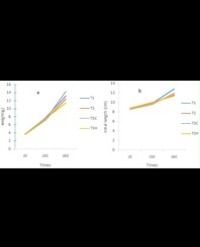
The growth response of the fish larvae under the five different photoperiod regimes (T1-T5) in six weeks after hatching is presented in Table 4. There were significant differences (p<0.05) in growth performance of hybrid (H. bidorsalis X C. gariepinus) larvae. The mean weight gain value was highest in T5 (91.2±0.21) mg, followed by T4 (86.0±0.20) mg and least in T1 (59.0±0.22) mg respectively. The instantaneous growth rate expressed as Specific Growth Rate (SGR) was significantly highest (p<0.05) in T5 (9.16) and least in T1 (8.22).
Table 4: Growth response of hybrid catfish (hetero-clarias) larvae in six weeks after hatching.
| |
Photoperiod Regimes |
| Growth Parameters |
T1 (24L:0D) |
T2 (18L:6D) |
T3 (12L: 12D) |
T4 (6L:18D) |
T5 (0L:24D) |
| Initial Mean Weight (mg) |
1.5 ± 0.01 |
1.5 ± 0.01 |
1.5 ± 0.01 |
1.5 ± 0.01 |
1.5 ± 0.01 |
| Final Mean Weight (mg) |
60.5 c ± 0.20 |
63.6 c ± 0.22 |
76.8 b ± 0.20 |
87.5 b ± 0.20 |
92.7 a ± 0.20 |
| Average Weight gain (mg) |
59.0 c ± 0.22 |
62.1 c ± 0.20 |
75.3 b ± 0.22 |
86.0 a ± 0.20 |
91.2 a ± 0.21 |
| SGR |
8.22c |
8.33c |
8.75 b |
9.06b |
9.16a |
Means values with similar superscripts along the horizontal row are not significantly different (P>0.05).
Discussion
The effect of photoperiod on the reproduction of fish species is an important factor to be studied [14]. The duration of exposure to light and darkness of fish gametes influences eggs fertility, hatchability and survival of the fish larvae [15]. In this study, eggs incubated under the total darkness of 24 hour had the highest hatchability, while the lowest hatchability was recorded in the 24 hour light exposure. This was in line with the result obtained by Okwiri (2015), on the hatchability of O. niloticus eggs using white light as background, which recorded poor hatchability [16]. This study further showed that larvae of hybrid catfish (Hetero-clarias) were photophobic like Heterobranchus bidorsalis [17]. But contrary to the report of Puvanendran and Brown (2002) that observed highest growth rate and survival of G. Morhua larvae under 24 hour photoperiod (continuous light exposure) [8], this study indicated best growth performance of hetero-clarias larvae under complete darkness. The difference in reaction to photoperiod is most likely attributed to the different conditions of the environments that the fishes were collected from, which may affect the functionality of their visual system to food [18]. G. Morhua is a photoreceptor and marine fish, unlike hetero-clarias that is of freshwater origin. With this in mind, the natural environment of a fish should be taken into consideration when determining the correct photoperiod for its reproduction [19-20].
To improve the reproductive management of the hybrid catfish larvae, especially when rear in captivity, feeding under dark environment would be appropriate since the larvae are photophobic. Also in this study, since hatchability of eggs was very low under long light exposure, high percentage hatchability of eggs of hybrid catfish in hatcheries should be under complete darkness. Despite the highest growth performance recorded at 24hour of darkness in this study, deformed fish larvae were equally highest compared to other photoperiod regimes. This observation could be related to the assertion of El- Sayed and Kawanna, (2007) that fish species exposed to incorrect hour of photoperiod could be severely crippled and may not develop properly [21]. In addition, photoperiod may not be the only variable affecting morphology, feeding, growth and survival rates of fish larvae [22]. Though some tropical fish species thrive in extended photoperiods [23], to have a successful propagation of this species, continuous light exposure should be avoided since it impairs development.
In this study, highest survivability of fish fry at six weeks of experiment was recorded under equal light and dark exposure (12L:12D). This result was close to the findings of Kiyono and Hirano (1981) on Mylio macrocephalus (Black porgy) who reported that under a 13 hour photoperiod there was a higher survival rate than at extended photoperiod [24]. Also, similar to the result obtain in this study, Puvanendran and Brown (2002) reported that larvae of Salmo gairdneri kept under moderate darkness had a significantly higher specific growth rate, survival rate compared with larvae reared at other photoperiod regimes [8]. It is expected that increased photoperiod is often associated with increased activity levels through the amount of exercise the fish larva performs [9]. These effects vary based on the species and larvae stage being studied [23]. Some fish larvae perform considerably better under longer light exposure, while others suffer under the same conditions. Luiz et al (2012) reported that fish larvae that cannot properly identify food due to low light exposure would have decreased survival and growth rate [14]. This report was contrary to the result obtained in this study in support of Adewolu et al (2008) that, photoperiod effects vary on species of fish and stage of growth of the larvae [23]. Feeding prior to utilization of barbells to search for food influences high survival and growth performances [25]. In this study, highest mortality of fish fry at six weeks of experiment was at longest hour of darkness (24h), due to observed cannibalism. Wasiu and Ofelia, (2014) reported cannibalism to be unavoidable in many fish species especially catfishes, therefore suggested adlibitum feeding and low stocking density [17].
Conclusion
The contribution of this study to the growth of aquaculture in Nigeria is the establishment of the appropriate photoperiods for the artificial propagation of hybrid catfish (hetero-clarias). The present knowledge would help in successful propagation of this species by incubating and hatching of eggs under complete darkness, while raising of healthy fish larvae with optimum survivability requires equal light and darkness exposure. In addition, the implications of inappropriate photoperiods from this study contribute to the understanding of the biology of hybrid catfish (Heterobranchus bidorsalis X Clarias gariepinus) to the growth of aquaculture. Exposing fertilized eggs to continuous light worsen hatchability, while longer darkness exposure reduces survivability of fish larvae. Future studies may look at the combine effect of other factors such as water transparency, water source, heat and source of live food with photoperiods on fish performance.
References
1. Adewumi AA, Olaleye VF. Catfish culture in Nigeria: Progress, prospects and problems. African Journal of Agricultural Research. 2011; 6: 1281-1285.
2. Adeogun OA, Ayinla OA, Ajana AM, Ajao EA. Economic impact assessment of hybrid catfish (Hetero-clarias) in Nigeria. Technical Report of National Agricultural Research Project (NARP). NIOMR, Victoria Island, Lagos, Nigeria. 1999: 27.
3. Olaleye VF. A review of reproduction and gamete management in the African catfish, C. gariepinus (Burchell). Ife Journal of Science. 2005; 7: 63-70.
4. Oresegun A, Oguntade OR, Ayinla OA. A review of catfish culture in Nigeria. Nigerian Journal of Fisheries. 2007: 4: 27- 52.
5. Phelps RP. Recent advances in fish hatchery management. Brazilian Journal of Animal Science. 2010; 39: 95-101.
6. Zheng W. Review, culture of catfish in China. Aquaculture. 1988; 75: 35-44.
7. Pena R, Dumas S, Saldivar-Lucio R, Garcia G, Trasvina A, Hemandez Ceballos D. The effect of light intensity on first feeding of the spotted sand bass Paralabrax maculatofasciatus (steindachner) larvae. Aquaculture Research. 2004; 35: 345-349.
8. Puvanendran V, Brown J. Foraging, growth and survival of Atlantic cod larvae in different light intensities and photoperiods. Aquaculture. 2002; 214: 131 151.
9. Batty R. Effect of light intensity on activity and food- searching of larval herring, Clupea harengus: A laboratory study. Marine biology. 1987; 94: 323 327.
10. Brown J, Puvanendran V. Effect of light intensity on the forging and growth of Atlantic Cod larva: Inter-population differences? Marine Ecology Progress Series, 1998; 167: 207-214.
11. Aluko PO, Ali MH. Production of eight types of fast growing intergeneric hybrids from four Clariid species. J. Aqua. Trop. 2001: 16: 139-147.
12. Jensen AL. Berverton and Holt life history invariants results from optimal trade-off of reproduction and survival. Can J Fish. Aquat.Sci. 1996; 53: 820 822.
13. Duncan DB. Multiple ranges and multiple F-tests. Biometrics. 1955; 11:1-42.
14. Luiz GG, Haluko M, Joao BKF. Effect of photoperiod on reproduction of Siamese fighting fish (Betta splendens) R. Bras. Zootec. 2012; 41: 821-826.
15. Watanabe WO, Woolridge CA, Daniels HV. Progress toward year-round spawning of southern flounder broodstock by manipulation of photoperiod and temperature. Journal of the World Aquaculture Society. 2006; 37: 256 272.
16. Okwiri B. Effect of tank background color on the hatchability of O. Niloticu eggs and survival of fry. International Journal of Fisheries and Aquatic Studies.2015; 2: 81-86.
17. Wasiu AO, Ofelia GO. Embryonic and larval developmental stages of African catfish Heterobranchus bidorsalis (Geoffroy Saint Hilaire, 1809) Teleostei, Clariidae). Springerplus.2014; 3: 677.
18. Downing G, Litvak MK. The effect of photoperiod, tank colour and light intensity on growth of larval haddock. Aquaculture International. 2000; 7: 369-382.
19. Bromage NR, Porter M, Randall C. The environmental regulation of maturation in farmed finfish with special reference to the role of photoperiod and melatonin. Aquaculture. 2001; 197: 63-98.
20. Appelbaum S, Kamler E. Survival, growth, metabolism and behaviour of Clarias gariepinus (Burchell) early stages under different light conditions. Aquacult. Eng. 2000; 22: 269-287.
21. El-Sayed AFM, Kawanna M. Effects of photoperiod on growth and spawning efficiency of Nile tilapia (Oreochromis niloticus L.) broodstock in a recycling system. Aquac Res 2007; 38: 1242-1247.
22. Boeuf G, Le Bail PY. Does light have an influence on fish growth? Aquaculture. 1999; 177: 129-152.
23. Adewolu MA, Adeniji CA, Adejobi AB. Feed utilization, growth and survival of Clarias gariepinus (Burchell 1822) fingerlings cultured under different photoperiods. Aquaculture. 2008; 283: 64-67.
24. Kiyono M, Hirano, R. Effects of light on feeding and growth of black porgy Mylio macrocephalus (Basilewsky), post larvae and juveniles. Cons. Int. Explo Mer. 1981:178: 334-336.
25. Olaniyi WA, Omitogun OG. Stages in the early and larval development of the African catfish Clarias gariepinus (Teleostei Clariidae). Zygote. 2013; 22: 314-330.